Commercial vs Residential Pressure Washing — Equipment, Insurance, and Scheduling
Commercial work needs heavier equipment, full COI insurance, multi-day scheduling, and EPA run-off compliance. Here's what property managers need to know.
The Short Answer
The main difference between commercial vs residential pressure washing comes down to specialized equipment scale, mandatory EPA water reclamation, and strict $1M+ insurance limits. You know how quickly a simple maintenance project can turn into a liability nightmare if an underprepared vendor shows up. If you want to skip straight to a solution, you can jump to commercial pressure washing to see how these standards fit into our broader service capabilities.
This guide answers your question directly for properties in Cape Coral or the wider Southwest Florida service area. Property managers comparing vendors must understand exactly why commercial work requires specialized equipment, strict insurance limits, and careful crew scheduling.
Our team has been doing this across Cape Coral, Fort Myers, Naples, Bonita Springs, Estero, Punta Gorda, Sanibel, Captiva, and Babcock Ranch for over 20 years. That specific local experience shapes the practical advice we share below.
You will see how we handle EPA-compliant chemistry and ARMA-aligned soft wash techniques where they apply. We never rely on pushy sales tactics after a job is done.
Here are the core differences to look for:
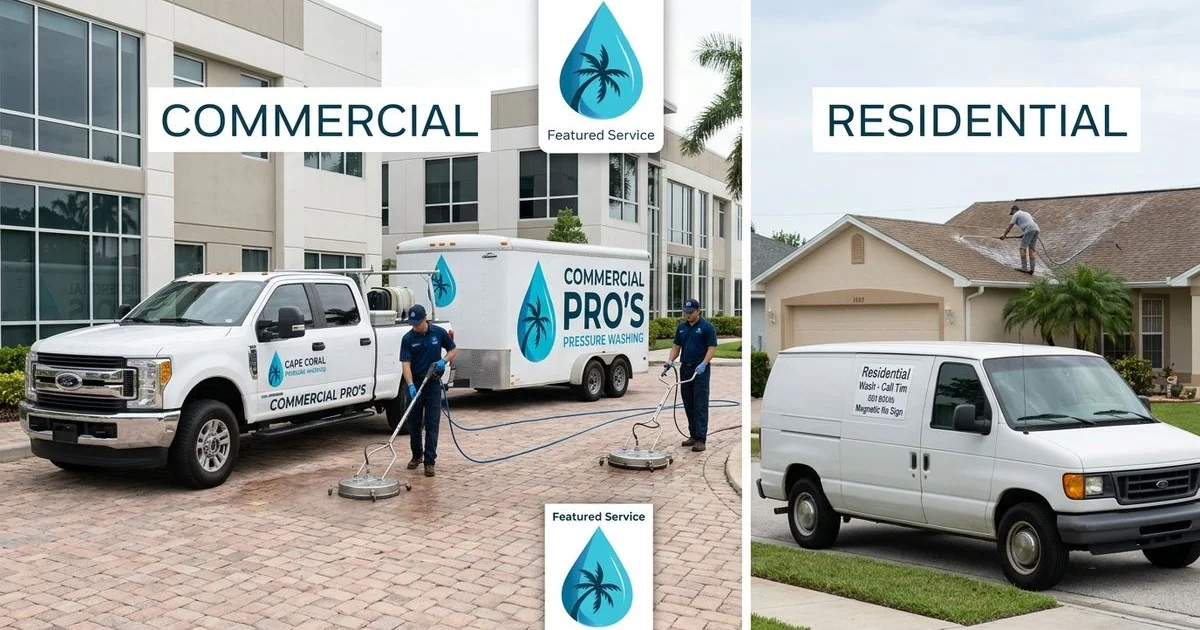
- Equipment scale: trailer-mounted closed-loop commercial rigs versus residential van setups
- Insurance requirements: commercial COI demands $1M+ per occurrence liability
- Operational logistics: multi-day scheduling and strategic crew rotation
Comparing Your Options
Commercial properties require closed-loop water reclamation and $1M liability policies, while residential jobs rely on basic runoff diversion and lower insurance thresholds. Most Cape Coral homeowners and facility directors ask about these exact differences when they evaluate their options. The wrong method costs more in the long run because it causes voided roof warranties, etched stucco, blown-out screen panels, and dead landscaping.
Southwest Florida conditions are incredibly unforgiving on building materials. Shortcut contractors frequently compound the damage by using residential tactics on commercial-scale problems. Our crews document the specific method on every single job. This gives you concrete proof of warranty-aligned work and EPA-compliant chemistry.
Water Reclamation and EPA Compliance
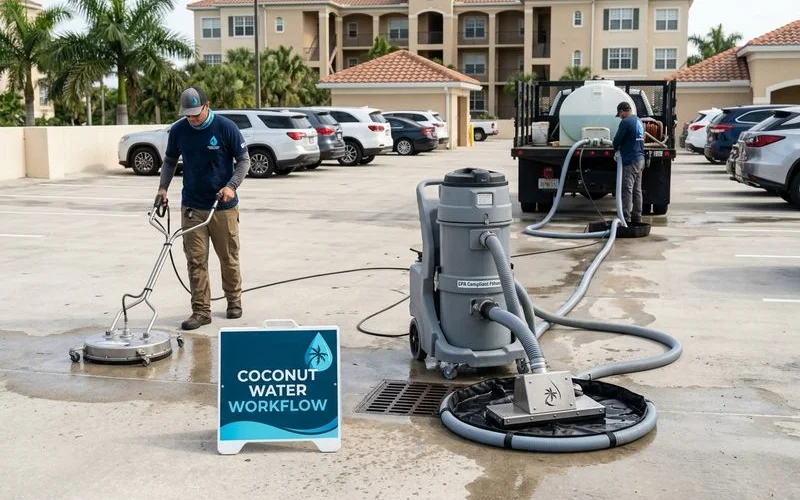
Commercial properties require strict water reclamation for parking decks and hardscapes to maintain Clean Water Act compliance. Florida Department of Environmental Protection (FDEP) regulations strictly prohibit wash water from entering storm drains. Violations can trigger EPA run-off penalties ranging from $10,000 to $50,000 per day in Florida.
We use closed-loop mobile vacuum systems to capture runoff at the point of cleaning. This contained water is then disposed of properly rather than flowing into the street. Residential setups rarely feature this level of containment. A standard van setup usually lets runoff divert into landscaping, which only works for small-scale residential jobs with minimal chemicals.
Insurance and COI Requirements
Liability coverage is a major dividing line in this industry. Residential cleaners might carry a basic policy, but commercial coi pressure washing requires specific documentation. Property managers should demand a Certificate of Insurance (COI) showing at least $1,000,000 per occurrence and a $2,000,000 aggregate limit.
Our standard operating procedure includes providing these exact commercial limits before we step foot on a property. Adequate coverage protects your association from slip-and-fall claims or third-party property damage. Anything less than a $1M policy is a massive red flag for a commercial contract.
Application Methods: Soft Washing vs. High Pressure
The Asphalt Roofing Manufacturers Association (ARMA) explicitly warns against using high-pressure wands on asphalt shingles. Their guidelines mandate a soft wash method using under 500 PSI, which is roughly the pressure of a standard garden hose. Using a high-pressure commercial wand on a roof will instantly void the manufacturer warranty.
We pair this low-pressure approach with a specialized mix of sodium hypochlorite and surfactants to kill algae at the root. This chemical treatment is perfect for residential roofs and delicate commercial siding. Conversely, heavy-duty commercial concrete cleaning requires 3,000+ PSI to blast away grease and oil stains.
| Feature | Residential Pressure Washing | Commercial Pressure Washing |
|---|---|---|
| Typical Equipment | Van-mounted cold water units | Trailer-mounted hot water rigs |
| Water Management | Runoff diverted to landscaping | Closed-loop vacuum reclamation |
| Insurance Standard | $300k - $500k liability | $1M+ per occurrence COI |
| Primary Method | Soft wash for roofs/siding | High-PSI for concrete decks |
Local Context: Cape Coral & SWFL
Southwest Florida requires specialized exterior cleaning methods due to sustained humidity above 70%, peak summer heat over 90°F, and constant salt-air corrosion. We face these severe environmental conditions daily along the coast. Each of these local factors shapes the right approach to commercial pressure washing requirements in ways a national franchise checklist cannot capture.
Regional Environmental Challenges
Saharan Air Layer dust events sweep through from June through August, leaving a gritty residue on buildings. Hurricane recovery work also comes in massive, unpredictable waves. The underlying method remains similar across the industry, but the timing and chemical mixtures require deep local knowledge.
Community-Specific Protocols
For canal-front homes in Cape Coral, heavy salt residue accelerates rust on screen frames and outdoor metal fixtures. We treat these delicate structures with specialized salt-neutralizing detergents before applying low-pressure rinses. Aggressive blasting would simply destroy the fragile screen splines.
For HOA-managed communities like Sandoval and Pelican Preserve, Architectural Review Board (ARB) documentation matters just as much as the physical cleaning. Our project managers submit full chemical disclosures and insurance certificates well before the scheduled service date. This proactive step prevents delays and keeps property managers compliant with Florida’s NPDES (National Pollutant Discharge Elimination System) permit regulations.
For Babcock Ranch’s solar-powered community, the cleaning protocol must align perfectly with their strict sustainability values. We adapt the approach to the property by utilizing biodegradable, EPA-approved surfactants that break down harmlessly in the soil. Protecting the local watershed is a non-negotiable standard for these eco-conscious neighborhoods.
Ready to Schedule Your Service?
If you are ready to schedule a service, you can request a free quote today. We guarantee a same-day reply with absolutely no pressure or obligation to commit.
For deeper coverage on related exterior maintenance topics, browse our other guides. You can also jump straight to commercial pressure washing to see detailed pricing and the step-by-step process for the underlying service.