Water-Based vs Solvent-Based Paver Sealers: Why It Matters in SWFL
Water-based urethane breathes through SWFL humidity; solvent sealers trap moisture and cause milky-white failures. Why we use water-based in Cape Coral.
The Short Answer
If you have managed properties in Florida, you already know that our constant ground moisture demands a breathable, water-based paver sealer. Solvent-based sealers form an airtight trap that catches this rising humidity, inevitably creating a failed, milky-white stain across your driveway.
If you are comparing water based vs solvent based paver sealer quotes, this difference in chemistry directly impacts your driveway’s survival.
Our crews replace failed, peeling sealants across Cape Coral and the wider Southwest Florida area every single week. You might be tempted by a cheaper solvent quote, but that shortcut almost always leads to a costly stripping and restoration job later.
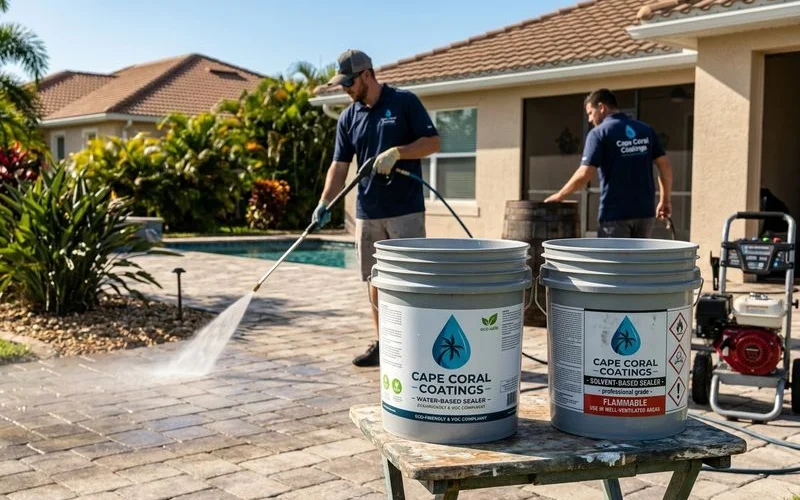
A quality water-based application simply performs better in a tropical environment.
Here is exactly why this chemistry justifies the initial investment:
- The Moisture Trap: Solvents lock water inside the stone, while water-based formulas breathe and release vapor.
- Blushing Failures: Florida’s high water table pushes moisture up, which hits the solvent barrier and causes a cloudy white haze.
- Lifespan Differences: Water-based sealers protect your pavers for 2 to 3 years.
- Rapid Degradation: Solvent products frequently peel and fail within the first 12 months in this heat.
We have spent over 20 years refining this process across Fort Myers, Naples, Bonita Springs, Estero, Punta Gorda, Sanibel, Captiva, and Babcock Ranch. The approach documented here relies on EPA-compliant chemistry and ARMA-aligned soft wash standards.
Your property deserves a careful, warranty-compliant treatment without any pushy sales tactics. When you want to see the full scope of this work, jump over to our paver cleaning & sealing guide to understand the complete process.
Comparing Your Options
Water-based sealers utilize water as a carrier to deliver protective resins into the stone, while solvent-based formulas rely on harsh chemicals like xylene or toluene. This fundamental difference dictates how the product smells, cures, and interacts with the Florida environment.
Property owners often ask us to explain the practical differences between these two paver sealer types.
You will notice the contrast immediately during the application process. We created a quick reference chart to show exactly how these products perform side-by-side.
| Feature | Water-Based Sealer | Solvent-Based Sealer |
|---|---|---|
| Breathability | High (Allows moisture out) | Zero (Traps moisture inside) |
| VOC Levels | Low (Usually under 100 g/L) | High (Often up to 400 g/L) |
| Application | Can be applied to damp pavers | Requires bone-dry pavers |
| Failure Risk | Low in humid climates | High risk of white blushing |
Odor and Environmental Impact
The fumes from a fresh sealing job can easily drift into your home or bother your neighbors. Solvent-based products contain high levels of Volatile Organic Compounds (VOCs).
While federal regulations allow up to 400 grams per liter of VOCs in concrete sealers, modern water-based formulas typically sit well below 100 g/L. This lower VOC content translates to a drastically reduced odor and a safer application zone for your landscaping and pets.
The Damp Application Advantage
Southwest Florida humidity rarely drops below 50 percent, which makes achieving completely dry stone incredibly difficult.
Water-based sealers can be applied directly to damp surfaces without compromising the bond. This capability saves you the typical 24 to 48 hours of drying time demanded by solvent chemicals. If a contractor attempts to speed up a solvent application on damp stone, the product will inevitably cloud and fail.
How to Identify Your Current Sealer
You must determine what coating currently sits on your driveway before scheduling a new application. We utilize a straightforward industry trick called the Xylene Test to find out.
Follow these basic steps to test your own stone:
- Find a hidden paver edge that receives minimal foot traffic.
- Place a few drops of liquid xylene directly onto the surface.
- Wait exactly 15 seconds for a chemical reaction.
- Touch the spot; a sticky feeling indicates a solvent-based sealer.
A water-based coating will ignore the chemical drop entirely and remain smooth.
Essential Questions for Your Contractor
Before you sign any estimate, ask the company these specific questions to protect your investment.
- What is the exact VOC rating of your proposed product?
- Can your sealant be applied to damp pavers?
- Will you strip the old solvent layer first, or just paint over it?
- How do you protect adjacent screen frames and stucco from overspray?
Choosing the wrong contractor can lead to severe property damage. Careless solvent overspray will etch your stucco, degrade sensitive screen enclosures, and void expensive roof warranties.
Our technicians photograph and document every step of the process to ensure warranty-aligned work. This exact record gives you proof of EPA-compliant chemistry and the correct approach for your specific material.
Local Context: Cape Coral & SWFL
The unique tropical environment of Southwest Florida demands breathable sealants because our high water table constantly pushes moisture up through the ground. A solvent-based product will invariably fail here, making a high-quality water-based option the best paver sealer florida properties can use.
Our region generates intense environmental challenges that you rarely see in other parts of the country.
During a typical Cape Coral morning, relative humidity frequently spikes to 90 percent around 7 AM. This staggering moisture level, combined with peak summer temperatures over 90 degrees, creates a brutal testing ground for exterior coatings.
These local factors dictate why a generic national franchise checklist simply will not work here:
- Persistent Ground Moisture: Proximity to the Caloosahatchee River estuary means a shallow water table, forcing vapor up through your driveway all year.
- Coastal Salt Air: Salt residue blowing in from the Gulf accelerates corrosion on screen frames and metal patio furniture.
- Saharan Dust: Heavy dust events roll through from June to August, requiring slick, sealed surfaces that are easy to rinse clean.
- Hurricane Debris: Post-storm recovery work demands durable sealants that can withstand heavy traffic and scraping branches.
Meeting Community Standards
Different neighborhoods require distinct management strategies.
Canal-front homes in Cape Coral face severe salt exposure, making a breathable, protective layer vital for long-term stone health. Properties inside strict HOA-managed communities like Sandoval and Pelican Preserve require detailed Architectural Review Board (ARB) documentation before any work begins.
Our administrative staff provides this paperwork directly to you, ensuring full compliance with local regulations.
For residents in the solar-powered community of Babcock Ranch, environmental impact remains a top priority. A low-VOC, water-based approach perfectly aligns with those sustainability values. We adjust our specific application method to fit the unique requirements of your property.
You deserve a transparent, pressure-free evaluation of your concrete and stone surfaces.
If you are ready to secure your driveway against the Florida elements, request a free quote today to get started. We guarantee a same-day reply with zero obligation attached.
For more detailed insights on property maintenance, browse our other guides. You can also jump straight to our main paver cleaning & sealing page to review exact pricing structures and see how this fits into the broader service.